Google Search Console’s Generative AI Report: What 33,600 Impressions Actually Show

Table Of Content
- What the Generative AI report actually shows
- Why 33,600 impressions is not 33,600 new visits
- What my top pages have in common
- Question titles carry the report
- Comparisons punch above everything else
- Length is not the lever
- The page that got picked up in eleven days
- How to read your own Generative AI report
- What I would change on a site based on this
- Expert take
- Want this done on your site?
- Frequently asked questions
- What is the Generative AI report in Search Console?
- Is the Generative AI report available to everyone?
- Does the report include clicks or CTR?
- Are AI impressions counted on top of my normal search impressions?
- Can I tell whether an impression came from AI Overviews or AI Mode?
- Does the report cover Google Discover?
- What kind of content gets the most AI impressions?
- Does a new website have any chance in AI search?
- Does longer content get cited more often by AI?
- Should I report AI impressions to clients as a result?
- Bottom line
Google’s Generative AI report in Search Console shows how often your pages appeared inside AI Overviews and AI Mode, and it reports impressions only. There are no clicks, no CTR and no query data in it yet, and the impressions it shows are a filtered subset of numbers already sitting in your standard Performance report rather than new traffic on top.
Google announced the report on June 3, 2026 and finished rolling it out to everyone around August 11. If you opened Search Console this week and saw a popup pointing at a report you have never used, that is this.
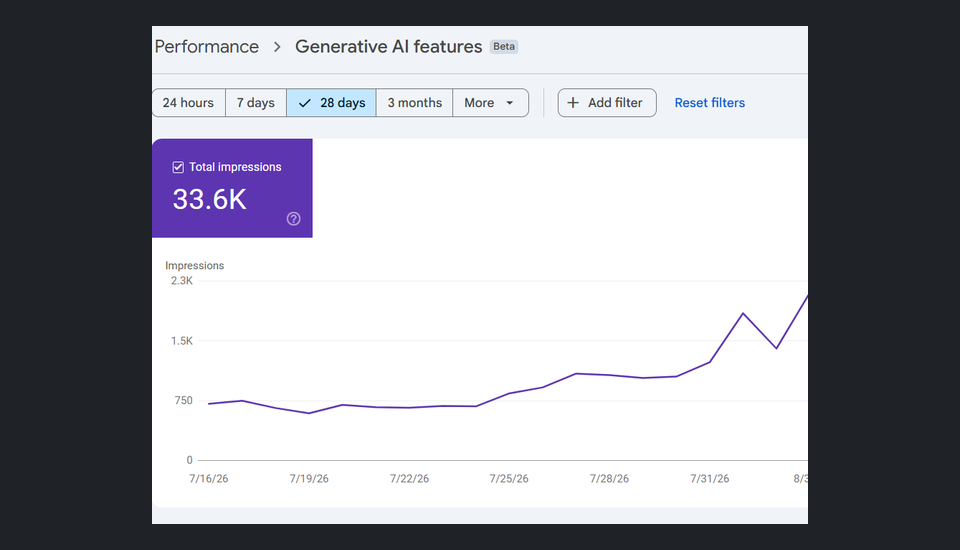
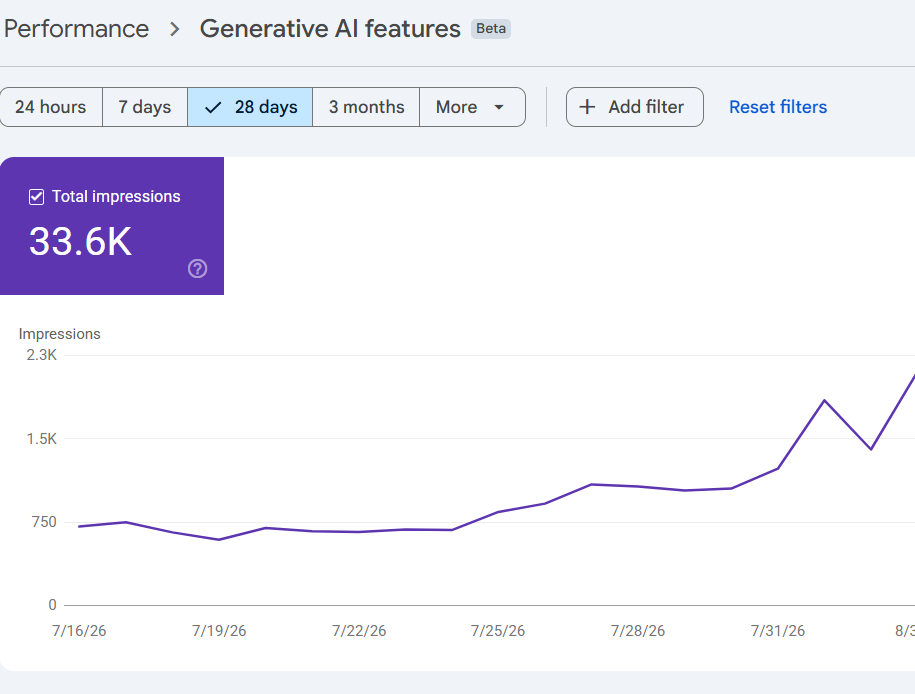
CriticNest is under six months old. Our first post went live on February 25, 2026. In the 28 days to August 13 the site picked up 33,600 impressions inside Google’s generative AI features, and the page-level breakdown says something useful about which pages AI features actually pull from.
- 33,600 impressions in 28 days on a site under six months old.
- 8 pages out of 76 produced just over 75% of every AI impression.
- Question-shaped titles dominate. Four of the top eight start with “is” or “does”.
- The single biggest page is a head-to-head comparison, beating second place by 54%.
- A post published August 3 hit 1,359 impressions in eleven days. Age of the page is not the gate.
- This is not extra traffic. It is a subset view of impressions you already had.
What the Generative AI report actually shows
The Generative AI performance report is a dedicated view of the impressions your URLs earned inside Google’s generative AI features. On the Search side that means AI Overviews and AI Mode. Generative features in Discover get their own separate report, and experimental Search Labs features are excluded entirely.
You get five things: impressions, the pages that earned them, countries, devices, and dates down to hourly granularity. That is the whole report.
What you do not get matters more. There is no click data, no CTR, and no query data. The report also does not tell you whether an impression came from AI Overviews or from AI Mode, which are very different surfaces with very different click behavior. Anyone selling you a precise “AI Overview ranking” off this report is reading something into it that is not there.
Why 33,600 impressions is not 33,600 new visits
This is the part most write-ups this week are getting wrong, so read it before you report a number to a client or a boss.
Google’s documentation is explicit that the Generative AI report draws from the Web search type of the existing Performance report. The impressions were always being counted. Google has isolated them into their own view so you can look at them separately. Your totals did not change and nothing new was added.
That means the honest way to use the number is as a share of visibility. AI impressions divided by total web impressions tells you what proportion of your search presence is now being routed through an AI surface. It does not tell you that you gained anything.
I would also hold off on drawing trend conclusions from a single 28-day window. The report is new, the rollout finished days ago, and the data history behind it is short.
What my top pages have in common
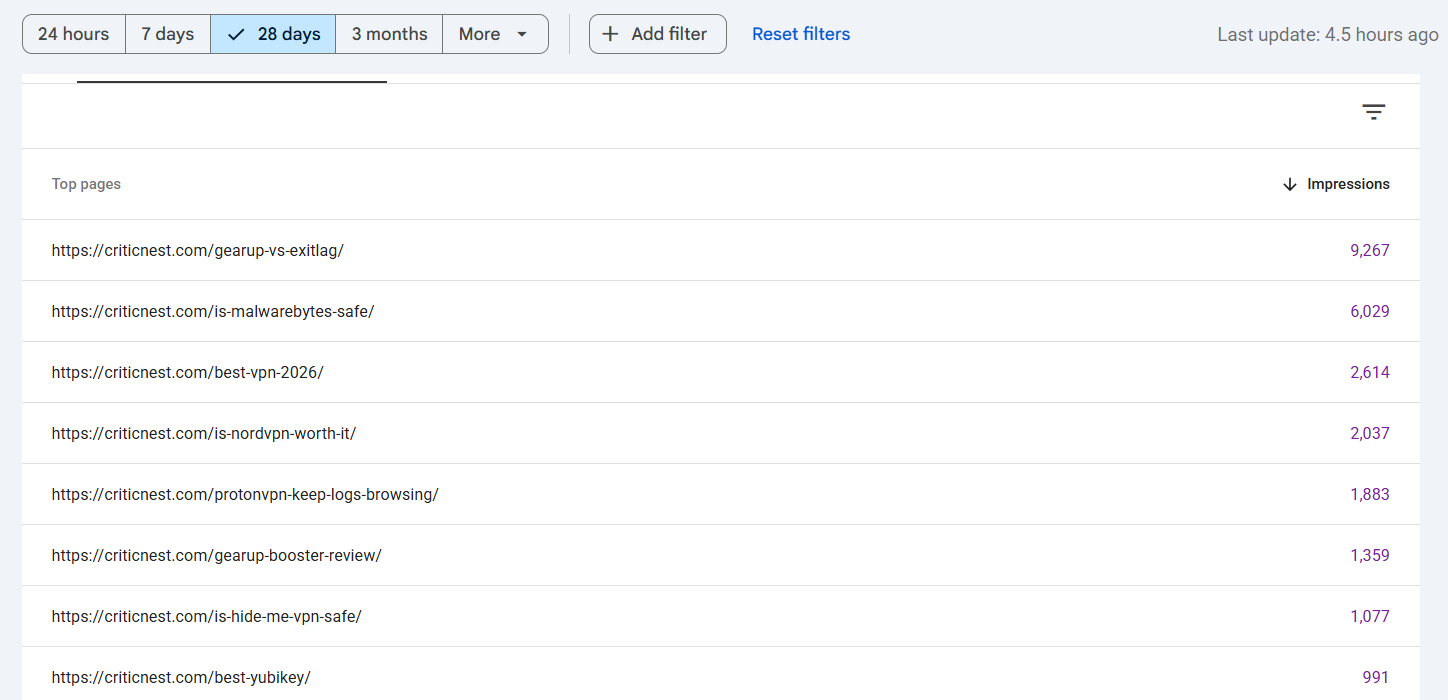
Here is the page-level breakdown, which is where the report earns its place. Eight pages out of 76 published produced just over 75% of the site’s total AI impressions. That is concentration, not breadth, and it changes how I would spend the next month of writing.
| Page | Title shape | Published | Impressions |
|---|---|---|---|
| GearUP vs ExitLag | Head-to-head comparison | May 7 | 9,267 |
| Is Malwarebytes safe | Safety question | Jun 5 | 6,029 |
| Best VPN 2026 | Listicle | Jun 26 | 2,614 |
| Is NordVPN worth it | Worth-it question | May 22 | 2,037 |
| Does ProtonVPN keep logs | Factual question | Mar 12 | 1,883 |
| GearUP Booster review | Review | Aug 3 | 1,359 |
| Is hide.me VPN safe | Safety question | May 25 | 1,077 |
| Best YubiKey | Listicle | Mar 26 | 991 |
Question titles carry the report
Four of the top eight are literal questions: is Malwarebytes safe, is NordVPN worth it, does ProtonVPN keep logs, is hide.me safe. These are not clever keyword plays. They are the exact sentence a person types, and an AI answer engine is built to match a question to an answer.
The pattern holds across the whole set. Every one of these pages opens by answering its own title inside the first two sentences, before any setup or context. That is a house rule at CriticNest and this report is the first hard evidence I have that it pays.
Comparisons punch above everything else
GearUP vs ExitLag alone produced 9,267 impressions, 54% more than the next page and more than a quarter of the site total. A head-to-head comparison gives an AI engine a structured, two-sided answer it can lift without having to synthesize anything.
Listicles show up twice in the top eight, which lines up with published research finding that roughly 41% of commercial AI citations go to listicle-format pages. Comparison and listicle formats are doing disproportionate work.
Length is not the lever
Worth saying plainly because it cuts against a lot of advice: Ahrefs found essentially no relationship between word count and citation position, a Spearman correlation of 0.04, with 53.4% of cited pages coming in under 1,000 words. My own top performers are not my longest posts. Structure and directness beat length.
The page that got picked up in eleven days
The GearUP Booster review went live on August 3. By the end of this reporting window it had 1,359 impressions inside Google’s AI features, from eleven days of existence.
That is the number I would point to if someone tells you a new site cannot compete in AI search. Domain age did not gate it. The page answers a specific product question directly, it sits inside an existing cluster of related posts on the same site, and it was picked up in under a two weeks.
How to read your own Generative AI report
The report sits under Performance in the Search Console sidebar, labeled Generative AI and marked Beta. Open it and do these four things in order.
1. Set the window to 28 days and note the total. Then open your standard Performance report for the same window and divide. That ratio is your AI visibility share, and it is the only number here worth tracking month to month.
2. Go straight to Top pages. This is the useful tab. Ignore the chart until you have a few months of history behind it.
3. Write down the title shape of every page in your top ten. Question, comparison, listicle, review, guide. Count them. You are looking for a pattern you can repeat, and you will usually find one.
4. Check publish dates against impressions. If your newest pages are absent, your problem is discovery or internal linking, not writing quality.
Do not bother exporting this into a client report as a headline win yet. With no clicks and no queries it cannot carry that weight.
What I would change on a site based on this
Four things, in the order I would do them.
Retitle before you rewrite. If a page covers a question but is titled as a topic, the cheapest available win is changing the title and the opening two sentences to match the question a person actually asks. No new content required.
Answer in the first two sentences, every time. Not after an introduction. The extractable block goes at the very top, and every H2 gets its own self-contained answer that could stand alone if lifted.
Build comparisons deliberately. If you have two product pages and no head-to-head between them, that comparison is the highest-value page you are not writing. Mine is the single biggest AI-impression page on the site.
Stop optimizing for length. The correlation is not there. Spend the effort on structure, FAQ blocks and schema instead.
If you want the deeper version of the how, I have written it up separately in how to rank in AI Overviews and how to get your business cited in ChatGPT. This post is the measurement half. Those two are the method.
Expert take
I have been doing SEO since 2018, mostly for medical practices and law firms across the US, and I run CriticNest as my own testing ground. Every claim on this page comes out of a property I control, which is the only reason I can show you the raw report instead of describing it.
What the report changed for me is prioritization, not strategy. I already believed question-shaped titles and answer-first structure were the right call. I did not have page-level proof of it until Google shipped this view. Now the argument is checkable.
The honest limitation: one site, one 28-day window, one vertical. Treat the direction as real and the exact percentages as provisional. I will republish this with a longer window once there is more history behind it.
Want this done on your site?
I take on a small number of SEO and AI-search clients directly. The work is what you just read: content structured to be answerable, clusters built properly, and reporting that tells you what the numbers actually mean rather than what sounds good.
If you would rather hire through a platform with escrow, contracts and public reviews instead of a form on a website you just found, that is fair. My profile is here: Ashikur R. on Upwork. Same person, same work, whichever route you prefer.
Frequently asked questions
What is the Generative AI report in Search Console?
It is a dedicated Performance view showing how many impressions your pages earned inside Google’s generative AI features. On Search that covers AI Overviews and AI Mode. It reports impressions, pages, countries, devices and dates, and nothing else at this stage.
Is the Generative AI report available to everyone?
Yes. Google announced it on June 3, 2026 as a limited beta and completed the rollout to all properties around August 11, 2026. It still carries a Beta label inside Search Console, so expect the metrics to change.
Does the report include clicks or CTR?
No. Impressions only. There is no click data, no click-through rate and no query data in the report right now. That is the single biggest limitation and it is why the report cannot yet prove commercial value on its own.
Are AI impressions counted on top of my normal search impressions?
No. Google’s documentation confirms the data comes from the Web search type of the existing Performance report. These impressions were already counted in your totals. The new report isolates them into a separate view rather than adding anything, so your overall search numbers do not change at all.
Can I tell whether an impression came from AI Overviews or AI Mode?
Not currently. The report combines both surfaces under generative AI features and does not break them out. Since the two behave very differently for clicks, that is a meaningful gap when you are trying to act on the data.
Does the report cover Google Discover?
Generative features in Discover are reported separately, in their own Generative AI performance report for Discover. The Search report and the Discover report are not combined into a single total, and the Discover version does not include a device breakdown. Check both views if Discover sends you meaningful traffic.
What kind of content gets the most AI impressions?
On CriticNest, question-shaped titles and head-to-head comparisons. Four of my top eight pages are literal questions and the single biggest page is a product comparison. Listicles also appear twice, matching published research on commercial AI citations. Reviews and standard guides trail well behind both formats.
Does a new website have any chance in AI search?
Yes. A review I published on August 3, 2026 collected 1,359 AI impressions within eleven days on a site under six months old. Domain age was not the barrier. Answering a specific question inside an existing content cluster mattered more.
Does longer content get cited more often by AI?
No. Ahrefs measured a Spearman correlation of 0.04 between word count and citation position, and found 53.4% of cited pages were under 1,000 words. Structure, directness and a clear answer near the top matter considerably more than length.
Should I report AI impressions to clients as a result?
Report it as a visibility share, never as traffic or revenue. Divide AI impressions by total web impressions for the same window. Without click data, presenting the raw impression count as a win is misleading and will not survive a follow-up question.
Bottom line
The Generative AI report is worth opening, worth checking monthly, and not yet worth building a strategy around on its own. Impressions with no clicks and no queries tell you where you are being shown, not what it is doing for you.
The page-level tab is the real value. Mine said something specific and repeatable: question titles and comparisons carry AI visibility, eight pages can carry three quarters of it, and a well-placed post can get picked up in eleven days regardless of how old the domain is.
Check yours, write down the title shape of your top ten, and write more of whatever is already winning.
Sources: Google Search Central, Introducing Search generative AI performance reports · Search Console Help, Generative AI performance report (Search) · Search Engine Land