
Google Review Policy Violations: All 20 Categories, and Which Ones You Can Win
 By Ashikur Rahman18 min read
Quick answer: Google judges every review against 20 named policy categories, from "Fake & Misleading Content & Behavior" to "Defacement & Mischief", and removes a review only when it breaks one of them. Roughly half of those categories can never apply to a business disputing a review, because a genuine bad experience breaks no rule. Google's help page says it plainly: "Do not report a review just because you disagree with it or dislike it." The categories a business can win on are fake engagement, coordinated ratings, off-topic text, personal information, harassment and competitor advertising, and the appeal form is the only place you get to name which one applies. Every category and quotation below was read from Google's own policy and help pages on 19 September 2026.
Why does Google remove some reviews and leave others?
The answer is shorter than the industry around it suggests. Google publishes a document called "Prohibited and restricted content" for everything users contribute to Maps, and reviews are judged against it. If a review's text, or the behaviour behind it, falls into one of the prohibited categories, Google can remove it. If it does not, the review stays, whether the business likes it or not.
That is why two facts keep colliding. Google blocked or removed 292 million policy-violating reviews in 2025, by its own April 2026 announcement, and 240 million the year before. Yet most owners who report a review get "Report reviewed - no policy violation" and conclude the system is broken. Both are true: Google removes enormous numbers of reviews that break its rules, and leaves the ones that merely hurt. So the useful skill is knowing the list well enough to tell, before filing, whether a named policy applies. This article is that list, read for one question: can a business win on this?
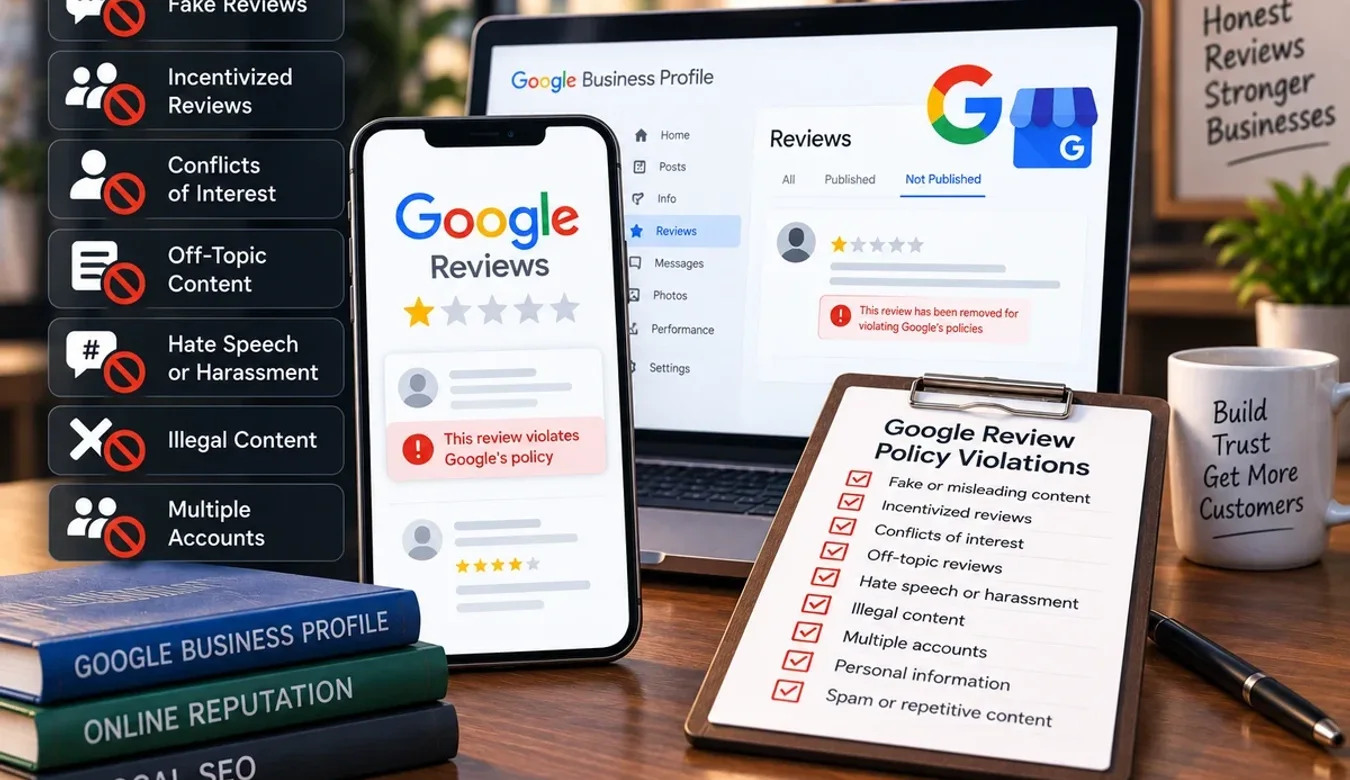
The 20 prohibited content categories, read for a business dispute
These are Google's own headings, in the order they appear on the policy page, with Google's one-line framing for each. The third column is my reading of whether a business disputing a review about itself can realistically make the case. "Never" does not mean the category is unimportant. It means the content does not turn up in a review of your business, or Google's own systems catch it without your help.
| Google's category | Google's framing | Can a business win on it? | Evidence that fits |
|---|---|---|---|
| Fake & Misleading Content & Behavior | "Contributions to Google Maps should reflect a genuine experience at a place or business." | Yes | No record of the reviewer in your booking, patient, invoice or CRM system; a review describing a service you do not offer |
| Rating Manipulation | Same genuine-experience rule, applied to coordinated or incentivised ratings. | Yes | A cluster of one-star ratings in a short window, repeated phrasing, accounts with no other contributions |
| Impersonation | "Don't use Google Maps to impersonate any person, group, or organization." | Rarely | A reviewer posing as your staff, a regulator or a named public figure |
| Misinformation | "False, inaccurate, or deceptive information can cause significant harm to individuals." | Rarely | A checkable false claim about health, safety or civic matters, not an opinion about service |
| Misrepresentation | "Misleading information can impact the quality of information on Google Maps." | Rarely | A review deliberately misdescribing what the business is or does |
| Harassment | "We don't allow users to post content to harass other people or businesses." | Yes | Repeated reviews from the same person, threats, a campaign aimed at a named employee |
| Hate Speech | "We do not allow posts that include any form of hate speech." | Yes, when present | Slurs or attacks on a protected characteristic, quoted exactly |
| Offensive Content | "We don't allow users to post offensive content." | Rarely | Gratuitously offensive text; a blunt complaint is not offensive content |
| Personal Information | "Do not distribute or post personal information without consent." | Yes | A staff member's full name with contact details, a licence plate, a home address, medical details about a third party |
| Obscenity & Profanity | "We will remove obscene and profane content on Google Maps." | Yes, when present | The exact profane words, quoted |
| Sexually Explicit Content | "We don't allow sexually explicit content." | Never in practice | Google's own filters remove this before you see it |
| Adult-Themed Content | "We do not allow adult-themed content." | Never in practice | Same |
| Violence & Gore | "We don't allow violent or gory content involving people or animals." | Never in practice | Same |
| Dangerous Content | "We don't permit users to post dangerous content." | Never in practice | Instructions for harm; not a review shape |
| Child Safety | "We do not allow content that puts children at risk." | Never in practice | Same |
| Terrorist Content | "Google Maps prohibits terrorist content." | Never in practice | Same |
| Off-Topic | "Only post content based on your experience or questions about experiences at a location." | Yes | Text that describes no visit, service, product or transaction; political commentary; a complaint about a different business |
| Advertising & Solicitation | "Don't post content for advertising or solicitation purposes." | Yes | A competitor's name, phone number, URL or promo code inside the review |
| Unclear and Repetitive Content | "Posting unclear or repetitive content dilutes useful information." | Rarely | The same review posted several times, or text with no discernible meaning |
| Defacement & Mischief | "We don't allow content that aims to destroy or damage the digital presence of a feature." | Rarely | Coordinated vandalism of a listing, usually alongside edits to the profile itself |
Count the third column and the shape of the problem is obvious. Six categories are a realistic "Yes" for a business. Two more are "Yes, when present", meaning the offending words either are or are not in the review and you will know at a glance. Six are "Never in practice", because they describe content Google's automated systems remove before an owner ever sees it. The remaining six are "Rarely", which is where most wasted reports go.
The review that breaks no rule at all
The review a business most often wants removed is not on the table and cannot be: the genuine one-star review from a genuine customer who had a genuine bad time. The tone can be unfair, the facts one-sided, the rating out of proportion. None of that is a policy category. Google's reporting page says exactly this: "Do not report a review just because you disagree with it or dislike it." That sentence explains most of the "no policy violation" statuses owners receive, because the point of the genuine-experience rule is that a real customer's real opinion belongs on the profile.
This matters tactically as well as honestly. Google's help page says you may put up to 10 reviews in one appeal submission, and each review gets a "one-time appeal". A hopeless case filed next to a strong one is not evaluated in isolation by whoever reads the batch. Filing the unwinnable review spends its one appeal and makes the rest of the batch read worse.
Reading the winnable categories properly
Each winnable category has a specific shape, and the evidence differs. The mistake I see most often is treating them as interchangeable labels and picking whichever sounds most serious.
Fake & Misleading Content & Behavior, and Rating Manipulation
For a single fake review the argument is that the person had no genuine experience with you, and the evidence is your own records: no appointment, no invoice, no patient file under that name or in that period. State what you searched and what you found. Do not argue the review is wrong in its details; argue the experience did not happen with you. For a cluster, the evidence is pattern rather than absence: ratings within days of each other, new accounts with no other contributions, repeated phrases. Lay the timeline out with dates. Google's April 2026 announcement says its systems now detect spam spikes and can pause new reviews on a profile while they are assessed, so a pattern you can see, Google's systems may see too.
Off-Topic, and Personal Information
Google's off-topic framing is precise: "Only post content based on your experience or questions about experiences at a location." A review describing no service, product, visit or transaction is off-topic by definition, as is political commentary or a complaint about a different company with a similar name. Quote the text and point out that it contains no experience at your location. Personal information is narrower than owners hope: a first name is not a violation, but a full name with a phone number, a home address, a car registration, or medical or financial details about anyone is. For a medical or dental practice this also covers reviews disclosing another patient's details. Quote only the words that carry the information.
Harassment, Advertising, and the "when present" pair
Harassment is repetition and targeting: the same reviewer returning under new accounts, threats, a review aimed at an individual rather than the service. A single angry review is not harassment; a sixth one from the same person is. Advertising & Solicitation is the cleanest category on the list, because a competitor's name, link or promo code is right there in the text. Hate Speech and Obscenity & Profanity are the "when present" pair: if a slur or obscene language is in the review, quote it exactly so the reader at Google does not have to find it.
Work with me
Which category does your worst review actually break?
Most of the reviews people want gone do not break any of the twenty rules on this page. A few of them break one cleanly, and the business owner has usually filed those under the wrong reason or not at all. The difference between the two groups is not obvious from the star rating or the tone. It comes from reading the text against the policy list line by line, and from checking your own records for the reviewer.
Send me the link to your profile. I will go through every negative, tell you which named category applies to each one, and be blunt about the ones where nothing applies. That sorting costs you nothing and you keep the list either way. If you then want the arguable ones filed and argued properly, the dispute service and its published prices are on this site, so you know the number before we speak.

Ashikur Rahman
SEO and AI Search Specialist
The contact links above go to me directly, so I earn from it if you hire me. Nothing else on this page is a paid placement.
The categories that waste your one appeal
Six categories sit in the "Rarely" column, and they attract a disproportionate share of reports because their names sound like they should fit. Misinformation is the worst offender. An owner reads a false claim about their service and files it as misinformation, but Google's framing is "False, inaccurate, or deceptive information" that "can cause significant harm to individuals", aimed at health, safety and civic falsehoods, not at a customer who misremembers what they were charged. A review that is wrong about your business is, in Google's terms, a review you disagree with.
Misrepresentation and Impersonation cover people pretending to be something they are not. Offensive Content sounds like it should catch a rude review, but bluntness is not offensiveness, and Google draws that line close to the obscenity end. Unclear and Repetitive Content is for text posted repeatedly or genuinely unintelligible, not for a short review. Defacement & Mischief is usually a profile-edit problem rather than a review problem. The practical rule: if you are stretching a category's wording to cover your review, it does not cover it. The categories that fit, fit obviously.
What the report menu does with these 20 categories
When you click Report you are shown a short menu of reasons. Google's help page does not list what that menu contains; it names two by example, "Spam" and "Profanity", so anyone quoting a fixed number of options is describing a screen they saw on a given day. Whatever the menu shows, it compresses the 20-category policy into a few clicks with no space for argument, and that compression is where good cases die. A fake review with a strong absence-of-record argument, filed under the closest menu item, arrives at Google as a bare selection. Google finds nothing in the text that trips a filter and returns "Report reviewed - no policy violation".
The appeal is the first place in the process where you can name the actual category and make the case in writing. The mechanics of the report, the statuses, the Reviews Management Tool and the one-time appeal are covered in how Google review removal actually works, so this article does not repeat them. What matters here is the sequencing: identify the category first, from the table above, then report, then when the report comes back negative, appeal with the category named and the evidence attached. Google says "Review evaluation typically takes several days" and publishes no success rate and no longer timeline, so plan for that and nothing more specific.
The same list, read from the other side
Search for why Google reviews get removed and half the people asking are reviewers whose own review vanished. The list above is the answer for them too. Google's help page on missing reviews says that "Reviews removed for policy violations won't be restored." If your review disappeared and it contained a staff member's full name and phone number, a competitor's link, profanity, or was one of several you posted about the same place, it fell into one of the categories above and is not coming back. Google also said in April 2025 that it now revisits reviews "more frequently to identify new abuse patterns even months after they were originally posted", so a review that stood for a year can still go when a pattern around it becomes visible.
A review can also be missing with no violation at all, through moderation delays, profile merges or a category-wide pause; those cases are in why Google reviews are not showing up, and a delayed review and a removed one look identical from outside.
The rules that apply to you, not the reviewer
The policy page also carries reviews-specific provisions aimed at businesses. Reviews must reflect genuine experiences without incentives, manipulation or conflicts of interest, and merchants cannot solicit specific content or discourage negative reviews. In plain terms: no paying for reviews, no discount for five stars, no reviewing your own business or a competitor's, no steering unhappy customers to a private form while sending happy ones to Google, no telling people what to write.
This is where a review problem becomes a profile problem. Google's 2025 figures include 782,000 accounts restricted and 13 million fake Business Profiles removed, and the enforcement side of the same rulebook is a suspension, covered in what to do when a Business Profile is suspended. Paying a reviewer to take a review down is a violation in its own right: Google treats it as manipulation, and in the United States the Federal Trade Commission's 2024 rule on fake and manipulated reviews bans buying, selling or suppressing reviews. Google's April 2026 announcement describes the mirror image too, new detection for scams that "demand payment in exchange for removing fake one-star reviews".
Below the prohibited categories sits a section on restricted content, regulated goods such as alcohol, gambling, firearms and medical devices. It governs what contributors may promote inside a review. It does not limit a business in a regulated category from disputing one; a dental practice disputes under the same 20 categories as a bakery.
A decision table before you file anything
| What the review is | Likely category | Verdict | What to do |
|---|---|---|---|
| Reviewer has no record in your systems | Fake & Misleading Content & Behavior | Win | Document the records search, quote any impossible detail, report then appeal naming the category |
| Several negatives in a short window from thin accounts | Rating Manipulation | Win | Build a dated timeline, note repeated phrasing, file as one batch of up to 10 with the pattern explained once |
| Text describes no visit, product or service | Off-Topic | Win | Quote the text, state that it contains no experience at your location |
| Names a staff member with contact or private details | Personal Information | Win | Quote only the words carrying the personal information |
| Same person, repeated reviews, threats | Harassment | Win | Show the repetition and the targeting |
| Competitor name, link or promo code inside | Advertising & Solicitation | Win | Quote it; this is the fastest category |
| Slurs or profanity in the text | Hate Speech, or Obscenity & Profanity | Win when present | Quote exactly, no paraphrase |
| Contains a false claim about your business | Misinformation, as usually filed | Rarely | Reply publicly with the correction; file only if the falsehood concerns health or safety |
| Rude, blunt, one-sided | Offensive Content, as usually filed | Rarely | Reply publicly; do not spend the appeal |
| Real customer, real bad experience, harsh rating | None | Never | Reply, fix the service, earn newer reviews; do not report |
What to write in the appeal
An appeal is read by a person with a list, so write to the list. Name the category exactly as Google names it, then give the one fact that puts the review inside it: for a fake review, that you searched your records for the name and period and found nothing; for manipulation, the dates of each rating and what the accounts share; for off-topic, Google's own sentence about experience at a location followed by the review text; for personal information, only the words that carry it. Leave out how the review made you feel, how long you have traded, your five-star count, and any request for a timeline; Google says evaluation "typically takes several days" and nothing more. The narrower the appeal, the faster the reader finds the violation.
The short version
Google removes reviews for one reason: they fall into one of 20 named prohibited-content categories. Six are realistic for a business to win on, two more apply whenever the offending words are present, and the rest either never appear in a review of a business or are the ones people stretch to fit and lose. A genuine bad experience breaks no rule. Because each review gets one appeal and up to 10 can be filed together, sorting by category before filing is the whole game: file the fake, coordinated, off-topic, personal-information, harassing and advertising ones with the category named and the evidence attached, and answer the rest in public. The free triage above is exactly that sorting, and the priced dispute service is described in what it costs to remove a Google review. Reviews also feed how your business shows up on Google Maps, one more reason to spend the effort earning new ones rather than fighting the ones you cannot win.
Frequently asked questions
What are the Google review policy violations?
Google's "Prohibited and restricted content" policy for Maps lists 20 prohibited categories, running from Fake & Misleading Content & Behavior and Rating Manipulation through Harassment, Personal Information, Off-Topic and Advertising & Solicitation to Defacement & Mischief. A review is removable only if it falls into one of them; a genuine negative experience is not a violation.
Which Google reviews get removed?
Reviews that break a named policy category. For a business, that means reviews from people with no genuine experience of it, coordinated rating campaigns, text that describes no visit or service, reviews carrying someone's personal information, harassment, and reviews containing competitor advertising, hate speech or profanity. Google reported blocking or removing 292 million policy-violating reviews in 2025.
Why did my Google review get removed?
Because Google judged that it fell into one of the 20 prohibited categories, most often personal information, off-topic content, profanity, repetition, or a pattern suggesting it was not a genuine experience. Google's help page states that "Reviews removed for policy violations won't be restored," and Google says it revisits older reviews to catch patterns months after posting, so removal can happen long after publication.
Can a business get a negative Google review removed?
Only if the review breaks a policy category. A genuine negative review from a real customer breaks none, and Google's reporting page says "Do not report a review just because you disagree with it or dislike it." If the reviewer has no record in your systems, the text is off-topic, it contains personal information, or it is part of a coordinated cluster, you can report it and then appeal once, naming the category and attaching the evidence.
Is a false review a policy violation?
Not automatically. Google's Misinformation category covers "False, inaccurate, or deceptive information" that "can cause significant harm to individuals", aimed at health, safety and civic falsehoods. A review that gets a detail about your business wrong is usually treated as an opinion you disagree with. The stronger route, when it applies, is Fake & Misleading Content & Behavior: that the person had no genuine experience with your business at all.
How many Google reviews can I appeal at once?
Google's help page says you can select up to 10 reviews for a single appeal submission through the Reviews Management Tool, and that each review gets a one-time appeal. Because a batch is read together, filing hopeless cases alongside strong ones tends to weaken the strong ones, so sort by category before you file.
How long does Google take to review a reported review?
Google's only published statement is that "Review evaluation typically takes several days." The statuses are "Decision pending", "Report reviewed - no policy violation", and "Escalated - check your email for updates". Google publishes no success rate and no longer timeline, so any specific figure you read elsewhere is not Google's.
Does Google notify me when a review is removed?
Google publishes no commitment to notify a business when an individual review is removed for a policy violation. Its April 2026 announcement does say that when it detects a sudden spike in spam reviews it removes the fake content, pauses new reviews on the profile, alerts the Business Profile owner, and shows a public banner explaining the pause. Outside that scenario, the review simply disappears.
Can I pay someone to remove a Google review?
You can pay someone to report and appeal reviews under Google's policies on your behalf, which is a legitimate service. You cannot pay the reviewer, and nobody can delete a review directly. Paying or incentivising a reviewer is manipulation under Google's policy and, in the United States, is banned by the FTC's 2024 rule on fake and manipulated reviews. Any service that promises removal is promising a decision Google makes.
Do Google's review rules apply to how I ask for reviews?
Yes. The reviews-specific provisions say reviews must reflect genuine experiences without incentives, manipulation or conflicts of interest, and that merchants cannot solicit specific content or discourage negative reviews. Offering a discount for a review, reviewing your own business, or routing only unhappy customers away from Google all break the same policy your competitors' fake reviews break, and enforcement against a business can escalate from removed reviews to a suspended profile.
Transparency: every category name, quotation and process step in this article was read directly from Google's "Prohibited and restricted content" policy for Maps user contributions, from Google Business Profile Help's "Report inappropriate reviews on your Business Profile" and "About missing or delayed reviews" pages, and from Google's Keyword blog posts of 7 April 2025 and 16 April 2026, on 19 September 2026. Where Google publishes nothing, this article says so rather than substituting an estimate. The "Can a business win on it?" column is my own reading of those categories, not Google's. I sell the review dispute service described on this site myself, which is a commercial interest you should weigh when reading the recommendation above. There are no affiliate or tracking links on this page.