

How Do You Actually Get a Negative Google Review Removed?
 By Ashikur Rahman15 min read
Quick answer: you cannot delete a Google review, and neither can anyone you hire. You can report it, and Google decides. The part most businesses miss is that reporting and appealing are two separate steps. Google's own wording is that "If a flagged review doesn't qualify for removal, submit a one-time appeal." One appeal, per review. The report is a menu selection with no space to argue; the appeal is the first and only place you get to name the policy the review breaks and make the case. Google says "Review evaluation typically takes several days" and publishes no success rate at all, so treat any promise of removal, or of a turnaround, as a promise about something the seller does not control.
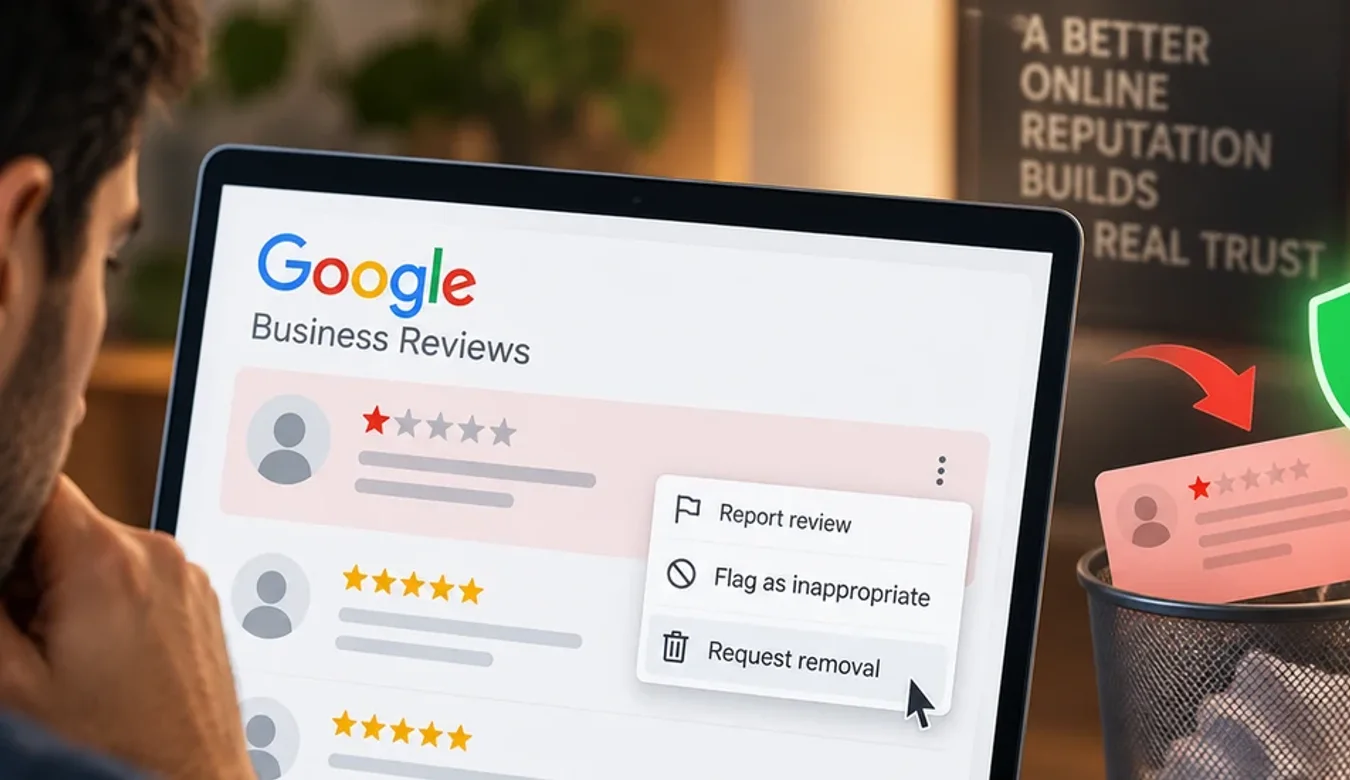
Reporting a review and appealing a review are two different things
Almost every business owner who has tried this has the same story. A one star review appears from someone they have never served. They click Report. A few days later the status changes to "Report reviewed - no policy violation" and the review is still sitting under their business name. At that point most people conclude that Google does not remove reviews and give up.
What actually happened is that the argument was never made. Reporting a review is a menu. You pick a reason from a short list and press send. There is no box for context, no place to attach the fact that the reviewer has no record in your booking system, no way to point out that the same paragraph appeared twice last month under two different names. The report is a signal, not a case.
The case belongs in the appeal, and the appeal is a separate action that most people never take because they assume the first refusal was the final answer. It is not. But it is close to final, because you only get one.
What Google actually says, in Google's words
The page that governs this is Google Business Profile Help, "Report inappropriate reviews on your Business Profile". Read on 18 September 2026, here is what it commits to.
On the basis for removal: "If you find a review on your Business Profile that violates Google policies, you can report it for removal." That sentence does a lot of quiet work. Removal is tied to a policy violation. It is not tied to the review being unfair, inaccurate, exaggerated, or written by somebody having a bad week. A genuine customer who had a genuinely bad experience and said so harshly has not broken a policy, and no amount of evidence changes that.
On the process, the steps are these.
| Step | What Google says to do | What it means in practice |
|---|---|---|
| 1 | Go to your Business Profile | The account that manages the listing. Agency-managed profiles trip here first. |
| 2 | Select Read reviews | Work from the full list, not from the notification email. |
| 3 | Next to the review you'd like to flag, select Report | One review at a time. There is no bulk report. |
| 4 | Select the reason to flag the review | This is the whole argument at this stage. Nothing else is transmitted. |
| 5 | Select Send report | Nothing further is required from you, and nothing further is possible. |
On how long it takes, Google gives exactly one phrase: "Review evaluation typically takes several days." That is the only duration on the page. There is no service level, no queue position, no committed maximum.
This is worth saying plainly because the search results for this topic are full of numbers. You will read that removals take 3 to 5 days, or that appeals take 7 to 14 days, or that a given provider wins some percentage of the cases it files. None of those figures comes from Google. Google publishes no review duration beyond "several days" and no success rate for reports or appeals, and I am not going to substitute a confident number of my own to compete with the confident numbers that are already there. Separately, the roughly three business day wait before a reported review becomes eligible for appeal is something third parties such as Sterling Sky report from watching the tool, not something Google states on its page, so treat it as a working expectation rather than a rule.
Where Google is precise is on status. The Reviews Management Tool returns one of three things, and each one means something different.
| Status | What it means | What to do |
|---|---|---|
| Decision pending | Flagged, not yet evaluated. | Wait. Filing again does not speed it up and muddies your record. |
| Report reviewed - no policy violation | Evaluated and refused. This is the one almost everybody stops at. | This is where the appeal exists. Use it, once, and only on the reviews worth it. |
| Escalated - check your email for updates | Google's definition: "The appeal has been escalated, and you'll get an email about the final decision." | Nothing. The decision now arrives by email and the tool stops being the place to watch. |
You get one appeal per review, and most businesses waste it
Here is the sentence that should change how you approach this. Google's wording is: "If a flagged review doesn't qualify for removal, submit a one-time appeal."
One time. Not one time per quarter, or one time per attempt. One appeal, for that review, and Google publishes no route to submit a second one. When the appeal is assessed, Google describes both branches and neither of them loops back: "If the review violates our policies, it will be removed. If the review complies with our policies, it will remain live."
There is a widespread belief that you can keep resubmitting with better evidence until something lands. That belief is real, but it belongs to a different Google process. Business Profile suspensions do have an additional review route where you can come back with stronger documentation, which is why so much published advice describes one. Applying that advice to a review appeal is a category error, and at least one page currently ranking for this topic tells a refused reader to submit another appeal with additional evidence, which contradicts Google's own one-time wording. If you want the suspension side of this, that is a genuinely different mechanism and I have written it up separately in what Google actually says about a suspended Business Profile.
The practical consequence is the whole reason this article exists. You have one argued shot per review. If you spend it the way you spent the report, by picking the nearest sounding reason and pressing send, you have used it up. And if you file ten reviews in one appeal submission, which Google permits, a weak case sitting next to a strong one is not evaluated in isolation by the person reading them.
Work with me
One appeal per review. Want it argued properly?
The reviews worth disputing are usually obvious once someone sorts them: the account with no record in your system, the post about a business you are not, the same complaint reposted under three names, the one naming a member of staff. The ones that will never come down are usually obvious too, and filing those is how a batch gets read badly.
Send me your profile link and I will tell you which of your negatives are actually arguable under a named policy, which are not, and in what order I would file them. If nothing on your profile is winnable, I will say that, and it costs you nothing to find out.

Ashikur Rahman
SEO and AI Search Consultant
The contact links above go to me directly, so I earn from it if you hire me. Nothing else on this page is a paid placement.
The report menu is short. The policy list is not.
Google's help page does not enumerate the reasons the report menu offers. It names two by example, Spam and Profanity, and leaves it there. So anyone telling you the exact number of report options is describing a screen they looked at, not a Google commitment, and that screen changes.
Meanwhile the policy those reports are judged against, "Prohibited and restricted content" in Google's contribution policy, names more than twenty separate categories. That gap is the entire opportunity. Your review is assessed against a long, specific, published list, and the reporting flow gives you a short menu to compress it into. The appeal is the first place you can say which of those named policies applies and why.
These are the ones that matter to a business disputing a review.
| Policy category | The situation it covers | What makes it arguable |
|---|---|---|
| Fake engagement | Reviews from accounts with no genuine experience of your business. | No record of the person in your booking, patient or invoice system. |
| Rating manipulation | Coordinated negatives, often in a cluster over a short window. | Timing pattern, repeated phrasing, accounts with thin histories. |
| Off-topic | Content that is not about an experience with this business. | The review text describes no service, product, visit or transaction. |
| Personal information | A named individual, contact details, or private details in the text. | Quote the exact words carrying the personal information. |
| Harassment | Attacks on a person rather than commentary on a business. | Named staff member, abusive characterisation, repeat targeting. |
| Repetitive content | The same complaint posted more than once. | Both posts side by side, with dates and account names. |
| Impersonation | An account posing as someone it is not. | Identity mismatch you can actually evidence, not merely suspect. |
| Misrepresentation | Reviews aimed at the wrong business, including mistaken identity. | The review describes a location, service or name that is not yours. |
Notice what is not on that list. There is no policy against being unfair, no policy against exaggeration, and no policy against a customer disliking a price. If your strongest argument is that the review is untrue, you are arguing about accuracy, and Google is not adjudicating accuracy.
Which reviews come down, and which do not
Sorting your negatives honestly before you file is the highest value hour in this whole process, because it decides what you spend your single appeal on. The split in practice runs roughly like this.
| Usually arguable | Usually not arguable |
|---|---|
| An account with no record anywhere in your system | A genuine customer describing a genuine bad visit |
| A review naming and attacking an individual member of staff | Complaints about waiting time or how long something took |
| The same text reposted under different names | Disputes about price, billing or a refund decision |
| A review that describes no service or visit at all | Harsh, one sided, but firsthand opinion |
| A review clearly meant for a different business | A star rating with no text, from a real customer |
Nobody selling you this service should be filing the right hand column. Filing it is not neutral either, because those cases go in as part of the same submission as your good ones.
What is actually left if the appeal is refused
This is the question I get most, and it deserves a straight answer rather than a reassuring one. If the appeal comes back and the review stays live, the in product route is finished for that review. What remains is genuinely thinner than the internet suggests.
You can contact Google Business Profile support directly. Google's own page points to its help contact route for disputes about automated spam removals, and a support conversation is a different channel from the tool, with a human on the other end and your case reference in hand. It is not a second appeal and it should not be described as one, but it is not nothing.
You can respond publicly, which is the option most owners undervalue. Everyone who reads the one star review also reads what sits under it. A calm, specific, non defensive reply that does not relitigate the complaint is read by far more prospects than the review alone, and unlike removal it is entirely within your control.
You can take legal advice. Google operates a separate legal removal path for content that "violates the law or your rights", which is a different mechanism from a policy report. Its published page does not enumerate Maps or Business Profile reviews among the products it covers, so treat this as a route your lawyer evaluates rather than a documented remedy, and be sceptical of anyone selling it as a reliable backstop.
And you can reduce the weight of the review, which is the only lever that works at any scale. One unremovable one star review against a steady flow of recent genuine ones is a footnote. The same review against eleven total reviews is your reputation. That is a visibility and volume problem rather than a dispute problem, and it is the same ground covered in how businesses actually get found on Google Maps.
How to write an appeal that is worth your one shot
An appeal that works reads like a complaint to a moderator, not like a complaint about a customer. Four things carry it.
Name one policy, not several. An appeal that argues a review is off topic and harassment and fake reads as someone hoping one of them sticks. Pick the strongest and commit to it.
Quote the review back. The reviewer's own words are your best evidence, because they are the only evidence the moderator can verify without leaving the screen. If the review names a member of staff, quote the sentence that names them. If it describes no service, say that the text contains no reference to any service, product or visit, and let the quoted text prove it.
Say what you checked, not what you believe. "This reviewer does not appear in our patient records" is a checkable statement about your own system. "This is obviously a competitor" is a theory, and theories weaken the paragraph they sit in. Never include customer data in an appeal; the fact that you checked and found nothing is the whole point, and the record itself is not Google's business.
File the strong ones first. Google lets you select up to 10 reviews when you appeal. That is a convenience, not an instruction. A submission stacked with weak cases is a worse submission, and the batch is your record.
If you manage more than one location, all of this runs per profile. The reporting, the appeal allowance and the batching are all attached to the individual listing, so a group is not one campaign but several, sequenced separately. Multi location businesses and businesses that travel to customers have some additional configuration exposure worth understanding, which I have covered in how Google treats a business that travels to its customers.
One thing that has changed, and it is not in your favour
Reviews used to be something people read on your profile. Increasingly they are something an AI answer summarises before anyone reaches your profile at all. When a generative result describes a business, the review corpus is part of what it is drawing on, and a summary does not distinguish between a refused dispute and a fair complaint. It reads sentiment.
That raises the cost of a cluster of unaddressed negatives, because their reach is no longer limited to people who scrolled far enough to see them. It also raises the value of the boring work: a steady flow of recent genuine reviews, a public reply under the bad ones, and a profile whose information is consistent everywhere it appears. If you want the mechanics of how those answers get assembled, I have written about what actually moves visibility in AI Overviews and how a business gets cited in ChatGPT.
Frequently asked questions
Can I delete a negative Google review myself?
No. The only person who can delete a review is the person who wrote it. What you can do is report it for removal, which asks Google to assess it against its content policies, and then appeal once if that report is refused. Anyone offering to delete a review directly is describing something that does not exist.
How long does Google take to decide on a reported review?
Google's page says "Review evaluation typically takes several days" and gives no other figure. There is no published maximum and no service level. Any specific day count you read elsewhere is an estimate from someone watching their own cases, not a Google commitment.
What does "Report reviewed - no policy violation" actually mean?
It means your report was assessed and refused. It is not a final verdict on the review, because the appeal still exists at that point, but it is the end of the reporting step. Most businesses read this status as the end of the road and stop, which is exactly why so many arguable reviews stay live.
Can I appeal a Google review decision more than once?
Not for an individual review. Google's wording is that you submit a one-time appeal, and it publishes no route to file a second one. The repeat submission process that a lot of articles describe belongs to Business Profile suspensions, which is a different mechanism entirely, so advice written about suspensions does not transfer here.
How many reviews can I appeal at the same time?
You can select up to 10 reviews in one appeal submission. Being able to fill that allowance is not a reason to. The reviews you include are read together, and padding a submission with cases that were never arguable does not help the ones that were.
Will Google remove a review just because it is untrue?
No, and this is the single biggest misunderstanding in the category. Removal is tied to a policy violation, not to accuracy. Google is not in a position to adjudicate whether your version of a visit or your customer's version is correct, so an appeal built purely on the review being wrong has nothing for a moderator to act on.
Can I pay someone to take a review down?
Paying anyone, including the reviewer, to remove a review violates Google's policies and falls under the FTC's 2024 rule on fake and manipulated reviews. It also tends to be the thing that turns one bad review into a compliance problem. A legitimate service reports and appeals; it does not transact with reviewers.
What happens to my other reviews while a dispute is running?
Nothing. Reporting a review does not hide it while it is assessed, does not affect your rating in the meantime, and does not touch the rest of your review corpus. The review stays visible throughout, which is another reason a public reply is worth writing on day one rather than after the outcome.
Should I hire someone for this or do it myself?
If you have one or two clearly arguable reviews and time to read the policy list properly, do it yourself; the tool is free and the process is public. Paying for help makes sense when there are enough negatives to need triage, when the arguable and unarguable ones are mixed together, or when a single appeal per review means you would rather not learn on your own case.
Is a guaranteed removal offer worth taking?
Treat it as a warning sign. Google decides the outcome, publishes no success rate and commits to no timeline, so a guarantee is a promise about a decision the seller does not make. What can honestly be promised is the work: every negative assessed against a named policy, the arguable ones argued properly, and a record of what was filed and what came back.
Transparency: every process step, status wording, quotation and policy category in this article was read directly from Google Business Profile Help, "Report inappropriate reviews on your Business Profile", and from Google's "Prohibited and restricted content" contribution policy, on 18 September 2026. Where Google publishes nothing, this article says so rather than substituting an estimate. I sell this service myself, which is a commercial interest you should weigh when reading the recommendation above. There are no affiliate or tracking links on this page.