
Is Semrush Overkill for a One Person Website?

Rewritten 4 August 2026, prices re-checked 19 September 2026. Semrush has retired the Pro, Guru and Business plans this article originally described. Every price below was read from the Semrush, Mangools and Ahrefs pricing pages on 4 August 2026, with Semrush and Ahrefs re-checked on 19 September 2026, and the piece no longer quotes the old lineup. The conclusion has not changed, because the entry price barely moved.
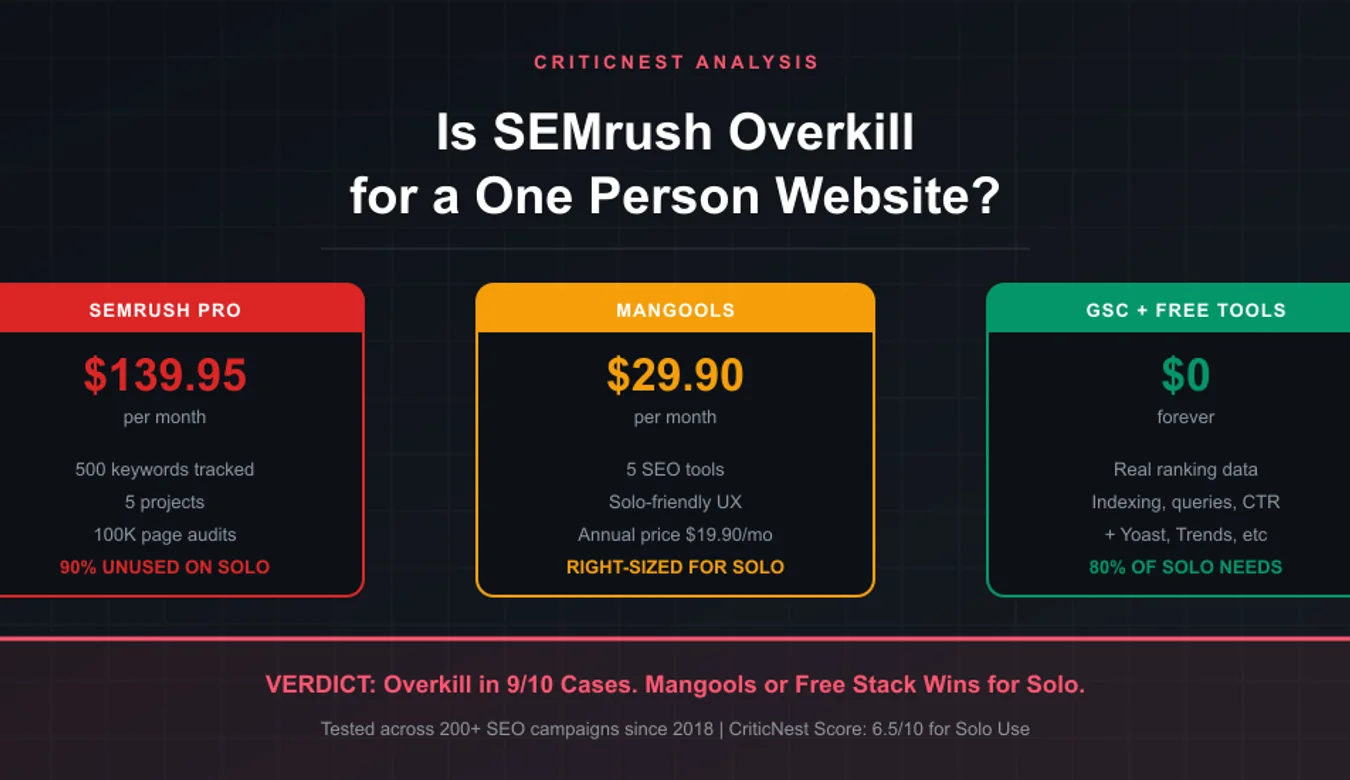
Yes, Semrush is overkill for a one person website in almost every case. The cheapest plan a new buyer can choose is $139 a month, or $117.33 billed annually, and it is sized for someone monitoring five websites and tracking 500 keywords every day. A solo blog or freelance site rarely uses a fraction of that.
The interesting part is not that Semrush is expensive. It is that the specific things you pay extra for, daily tracking on hundreds of keywords across multiple properties, are the things a one site owner has the least use for. Here is what the entry plan actually includes at today's prices, what a single site genuinely needs, and what to run instead.
What the Cheapest Semrush Plan Costs in 2026
Semrush restructured its lineup, and most articles about this question still quote plans you can no longer buy. The entry plan is now called SEO, at $139 a month or $117.33 billed annually, which is $1,407.96 for a year.
What that buys, from their own plan description: 5 websites to monitor, 500 keywords tracked daily, keyword research and competitor analysis, Position Tracking, Site Audit, and a set of AI search features covering AI visibility reports, AI sentiment monitoring and custom prompt tracking.
Read that list as a solo site owner and the mismatch is immediate. You monitor one website, not five. You care about perhaps 20 to 50 keywords, not 500. Daily tracking on 500 keywords is a genuinely valuable thing to sell to somebody with client reporting obligations, and close to worthless to somebody who checks their rankings on a Sunday.
- Four of the five website slots
- Roughly 450 of the 500 daily-tracked keyword slots
- Competitor analysis at a depth that only matters in contested commercial niches
- AI visibility reporting for any domain, when you only need your own
- The reporting add-ons that exist so you can bill somebody else
None of that is a criticism of the product. It is a description of who the product is priced for.
What a Solo Site Actually Needs from an SEO Tool
Strip the question down and the requirements list for one person running one website is short.
You need keyword research with volume and difficulty. You need to see what you already rank for, especially the page two and three positions where the cheapest wins live. You need on-page checks covering titles, descriptions, heading structure and schema. You need a site audit that flags broken links, slow pages and missing meta. You need to watch 20 to 50 priority keywords. That is close to the whole list.
Semrush does all of it well. So do tools costing a fraction of $139 a month. The question was never whether Semrush works for a solo site. It works. The question is whether one site justifies paying for capacity built around five.
The Semrush Ladder, and Where a Solo Site Falls Off It
All four current plans, at prices verified on 4 August 2026 and again on 19 September 2026. The three bundled tiers are sold as Semrush One; see what Semrush One costs.
| Plan | Monthly | Billed annually | Solo fit |
|---|---|---|---|
| SEO | $139 | $117.33 | Overkill |
| Starter | $199 | $165.17 | Wasteful |
| Pro+ | $299 | $248.17 | Absurd |
| Advanced | $549 | $455.67 | Not for you |
Two details worth knowing before you compare against anything else. Every plan includes exactly one user, with additional seats starting at $45 a month. And branded, white-labeled client reports are a separate $20 a month add-on, so the real entry cost for anyone reporting to a client is $159 a month rather than $139.
If you have decided you do want Semrush and are only choosing a tier, we worked through all four plans and every add-on separately in which Semrush plan you actually need. This page is about the prior question.
What to Run Instead
For a single site, two options cover almost everything, and the first one is free.
Google Search Console, $0. This is the backbone, not the consolation prize. Search Console shows the queries that brought you impressions, your real average position, your actual click-through rate and your index coverage. Every paid tool in this category is estimating what Search Console tells you exactly, and any tool that disagrees with it about your own site is the one that is wrong. What it cannot do is tell you anything about anybody else's site.
Mangools Basic, $18.85 a month billed annually. That is $226.20 a year against Semrush's $1,407.96, a difference of $1,181.76. You get five tools in one subscription: KWFinder for keyword research, SERPChecker for SERP analysis, SERPWatcher for rank tracking, LinkMiner for backlinks and SiteProfiler for site metrics. Their own page describes the plan as being for solopreneurs and freelance SEOs, which is accurate rather than aspirational. Two limits to know: Basic allows no extra seats at all, and rank tracking updates weekly rather than daily on every plan except Agency.
That is deliberately a short list. There are more good options under $50 a month than most people realise, including an Ahrefs tier at $29 that almost no comparison article mentions, and we priced six of them at source in Semrush alternatives under $50 a month.
When Semrush Is Worth It for a Solo Operator
Semrush is not always overkill. Four situations make the price defensible even for one person.
- You manage client sites as a freelancer. The entry plan monitors five websites and tracks 500 keywords daily. Spread across four clients the per-site cost drops below most alternatives, and daily tracking is something you can genuinely put on an invoice. This is the original use case and the honest one.
- Your single site earns real money. If the site clears several thousand a month, $1,407.96 a year is a rounding error against what one good keyword-gap discovery is worth.
- You write SEO content for hire. Client-facing briefs and branded reports are billable output, and the $20 reporting add-on is what makes them look like a product rather than a screenshot.
- You compete somewhere genuinely contested. In finance, insurance or SaaS, database depth is the actual product, and the cheap tools will show you fewer keywords and fewer links.
For a personal blog, a single local business site or a project with no revenue yet, none of these apply.
How This Comparison Was Researched
CriticNest is written by one person, Ashikur Rahman, who has worked in SEO since 2017 and runs client work through proximityranker.com. That background is why this site covers SEO tooling at all, and it is worth being precise about what it does and does not qualify.
What this article is. Every price and plan limit here was read directly from the vendor's own pricing page on 4 August 2026 and re-checked on 19 September 2026, not repeated from another article. That matters more than it sounds, because Semrush retired three plan names and a large share of the pages ranking for this question still quote figures no buyer will be shown today.
What this article is not. It is not a controlled side-by-side benchmark. No test was run comparing keyword volume accuracy, backlink index size or crawl coverage between these tools for this piece, so you will not find a claim here that one database is more accurate than another. The argument is about pricing against usage, which is a question you can settle from published limits, and it is the question the headline actually asks.
Semrush Privacy and Cancellation Terms
CriticNest reviews the privacy posture of every tool we cover.
Data collection. Semrush collects usage data including which reports you run, which keywords you research, which competitors you track and how often you log in, documented in their privacy policy and used for product improvement and upsell targeting. You cannot fully opt out and keep using the platform.
Data sharing. Semrush states it does not sell user data to third parties. Aggregated keyword data does feed their public databases, so researching an obscure keyword may statistically influence their public volume estimates. This is normal across the category and worth knowing rather than worrying about.
Ownership. Adobe completed its acquisition of Semrush on 28 April 2026, an all-cash deal valued at about $1.9 billion, and Semrush now operates as a wholly owned Adobe subsidiary. Published pricing has not changed as a result so far.
Trial and cancellation. Semrush offers a seven-day free trial that requires a card, and a small validity charge is taken and immediately refunded at signup. You can cancel, upgrade or downgrade at any time. The refund window is narrow and conditional, so set a calendar reminder for day six rather than relying on remembering.
Pros and Cons of Semrush for One Person Websites
- Daily rank tracking from the cheapest plan
- All-in-one platform, no tool sprawl
- Strong competitive intelligence
- AI search visibility included at entry
- Seven-day free trial before you commit
- $139/mo is priced around five websites
- Most capacity unused on a single site
- Branded reports cost $20 more
- A second seat starts at $45 more
- Trial requires a credit card
Who Should Use Semrush
Semrush is the right call if you manage three or more client sites, if your single site earns enough that competitor research drives real revenue decisions, if you produce SEO content for clients and need branded reports, or if you compete in a niche where each ranking position is worth thousands.
Who Should Skip Semrush
Skip it if you run a personal blog, manage one local business site, are starting something with no traffic yet, or your site revenue is under about $1,000 a month. In each of those cases Search Console alone, or Search Console plus Mangools at $18.85 a month, delivers the same decisions. The money saved is better spent on content, hosting or design tools like Elementor Pro, which I covered in my Elementor Pro for WooCommerce breakdown.
Frequently Asked Questions
Is Semrush worth $139 per month for a personal blog?
No. For a personal blog that is roughly seven times what you need to spend. Mangools Basic at $18.85 a month billed annually, or Google Search Console at $0, deliver the same decisions for one site. The Semrush entry plan is sized around monitoring five websites and tracking 500 keywords daily, and a personal blog uses almost none of that.
What is the cheapest way to do SEO for a one person website?
Google Search Console, which is free and gives you your real impressions, clicks, positions and index coverage rather than an estimate of them. Add the free Yoast SEO plugin for on-page work on WordPress. That stack costs nothing and handles most solo site SEO. The gap it leaves is competitor and keyword database research, which is the actual reason to pay for a tool.
How much does Semrush cost in 2026?
The current plans are SEO at $139 a month, Starter at $199, Pro+ at $299 and Advanced at $549, or $117.33, $165.17, $248.17 and $455.67 billed annually. The Pro, Guru and Business plans that older articles quote are no longer offered to new buyers, which is why price figures for Semrush vary so wildly across search results.
Can I use the Semrush seven-day free trial without paying?
Yes, but it requires a credit card, and a small validity charge is placed and immediately refunded when you sign up. Cancel before day seven and you pay nothing. Expect upsell emails during the week. Set a reminder for day six rather than trusting yourself to remember.
Is Mangools really comparable to Semrush for solo sites?
For one site, largely yes. KWFinder covers keyword research, SERPChecker the SERP analysis and SERPWatcher the rank tracking, at $18.85 a month billed annually. The database is shallower, which matters in contested niches and not much elsewhere. The two limits that catch people are that Basic includes no extra seats at all and that rank tracking updates weekly rather than daily.
Should I use Ahrefs or Semrush for my one person website?
Neither, if you genuinely have one site and no clients, because both are priced around multi-site work. The choice only becomes real once you are billing someone, and then it turns on whether you report rankings or do research, since Semrush tracks daily while Ahrefs updates weekly on every plan it sells. We worked that decision through properly in Semrush vs Ahrefs for freelancers.
Does Semrush have a free plan?
Semrush offers a capped free account that allows a limited number of lookups per day without a subscription. It is enough to spot-check a domain or a keyword, not enough to run ongoing SEO work. The seven-day trial is the only way to see the full platform without paying.
Does the Semrush entry plan include client reports?
Not the branded ones. Reporting is sold as an add-on: $10 a month for the base report with scheduling and PDF export, and $20 a month for the pro version that adds branding and white-labeling. If you send reports to clients under your own name, the real entry cost is $159 a month rather than $139.
Can I cancel Semrush mid-month and get a refund?
You can cancel, upgrade or downgrade at any time, but a monthly subscription runs to the end of the cycle you already paid for rather than stopping immediately, and there is no refund for unused time. The refund window on annual plans is narrow and conditional, so check the current terms at the point of purchase rather than relying on any article, including this one.
Who owns Semrush now?
Adobe. The acquisition completed on 28 April 2026, an all-cash deal valued at about $1.9 billion, and Semrush now operates as a wholly owned Adobe subsidiary. Published pricing has not moved because of it so far, but it is worth knowing before entering an annual commitment.
Final Verdict: Semrush Is Overkill for Solo Sites
Semrush is a strong platform aimed squarely at people who monitor several websites and answer to somebody about their rankings. One person with one site is neither of those. At $139 a month, or $1,407.96 for a year, you are buying capacity built around five websites and 500 daily-tracked keywords in order to use one website and perhaps forty.
Run Google Search Console, which is free and more accurate about your own site than anything you can buy, and add Mangools Basic at $18.85 a month if you need keyword research and competitor data. That saves $1,181.76 a year against Semrush's annual rate, and for a single site it will not cost you a single decision.
The exception stands: if you are a freelancer with several clients, an affiliate site earning well, or someone who writes SEO content for hire, Semrush earns its price. For everyone else with one website, buy for the scale you are at.
Disclaimer: This article is CriticNest's independent analysis of published pricing and plan limits, read from each vendor's own site on 4 August 2026, with Semrush and Ahrefs re-checked on 19 September 2026. It is not a controlled benchmark of data accuracy between these tools. CriticNest has no affiliate or commercial relationship with Semrush, Mangools or Ahrefs and was not paid for this review. Pricing changes often, so verify on the official site before purchasing.